Degraded 5G throughput on an urban route: three causes, three actions
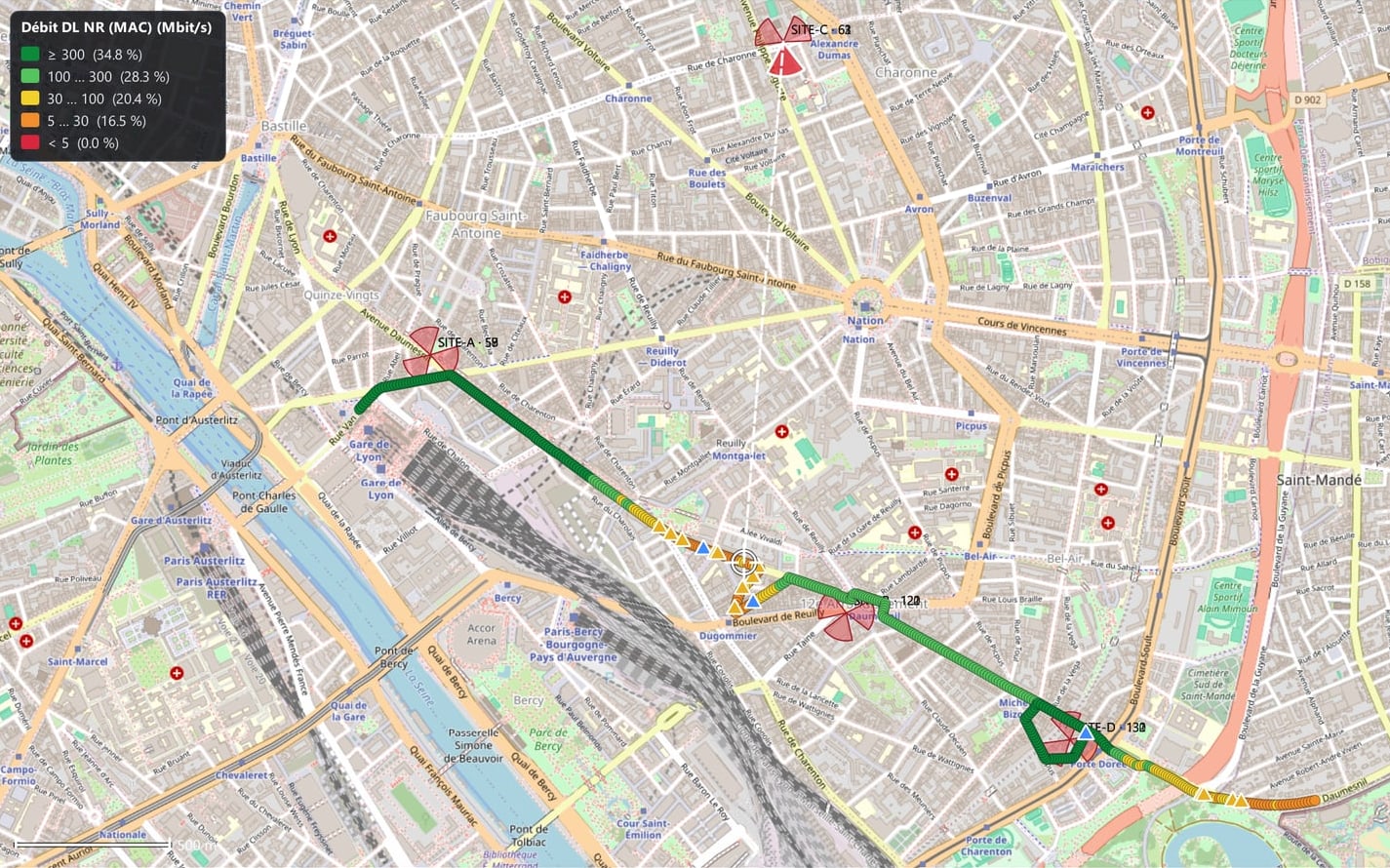
5G SA drive test, n78 band (100 MHz), 4.5 km urban route, continuous downlink transfer.
- Median DL throughput over the route
- 220becomes424 Mbit/s
- DL layers on the repaired sector
- 1becomes4
- Pilot pollution alerts
- 6becomes0
Symptom
Observations
On an urban route covered in 5G SA, customer complaints report throughput far below expectations. The diagnostic drive test, with a continuous downlink transfer, confirms it: throughput stays below 400 Mbit/s for two-thirds of the route (323 seconds of transfer out of 478), with a median of 220 Mbit/s.
Data collected
- A 5G SA test UE: chipset trace, GPS position, continuous HTTP downlink transfer
- The cell database for the area: sites, azimuths, tilts and antenna heights
- Analysis thresholds: low throughput below 400 Mbit/s, insufficient SINR below 8 dB, SINR rated good at 10 dB and above
Lessons learned
Key points
- 01
An acceptable RSRP guarantees nothing: in 5G, throughput is driven by SINR and the number of layers.
- 02
A layer count that does not follow SINR indicates a hardware problem, not a radio problem.
- 03
Not every degradation can be fixed by parameter tuning: a coverage edge is a planning matter.
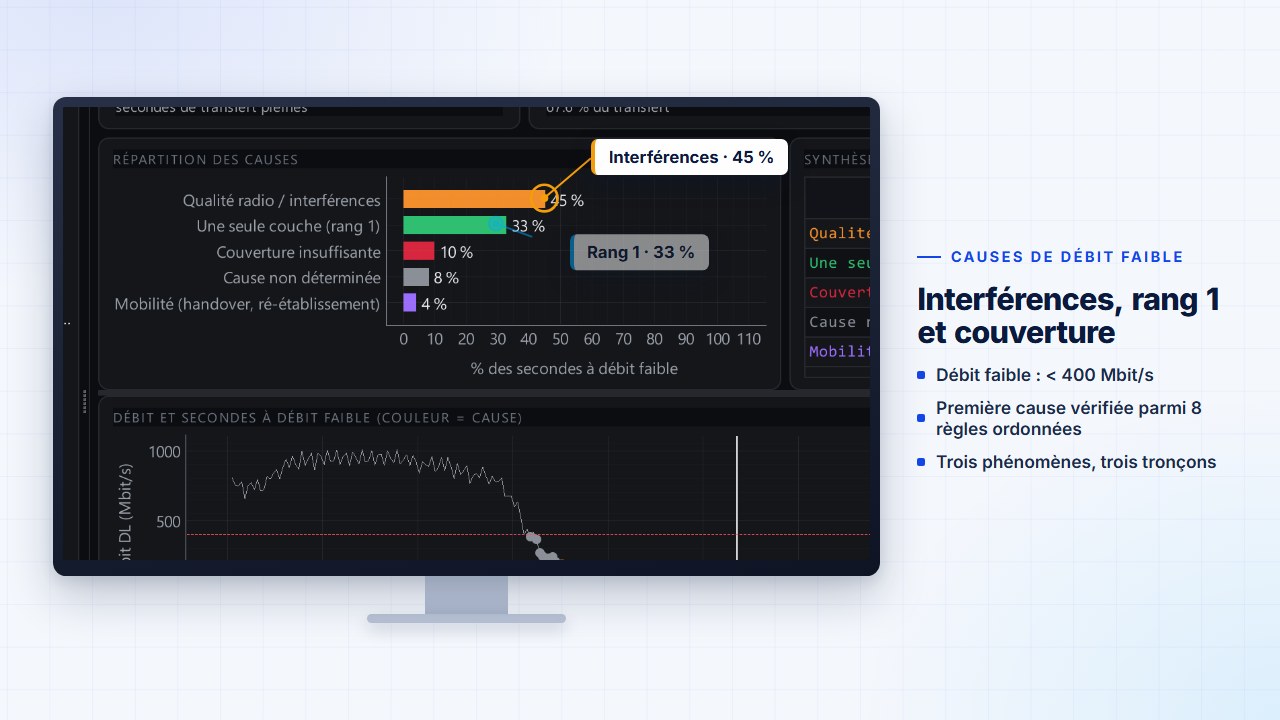 3 min 44 s
Video · 3 min 44 s
Case studies: three RF investigations
Degraded 5G throughput on an urban route, uplink noise rise on a shared DAS, pilot pollution on a high floor: three investigations replayed in AKCELL Analyzer, from symptom to verification after correction.
Chapter “Degraded 5G throughput on a route” at 0:10
AKCELL Analyzer
The same method, applied to your own traces.
Post-processing software: synchronized replay, decoded signaling, event engine, low-throughput causes, before/after comparison, benchmarking and reports.