Uplink noise rise on a shared DAS: diagnosing passive intermodulation
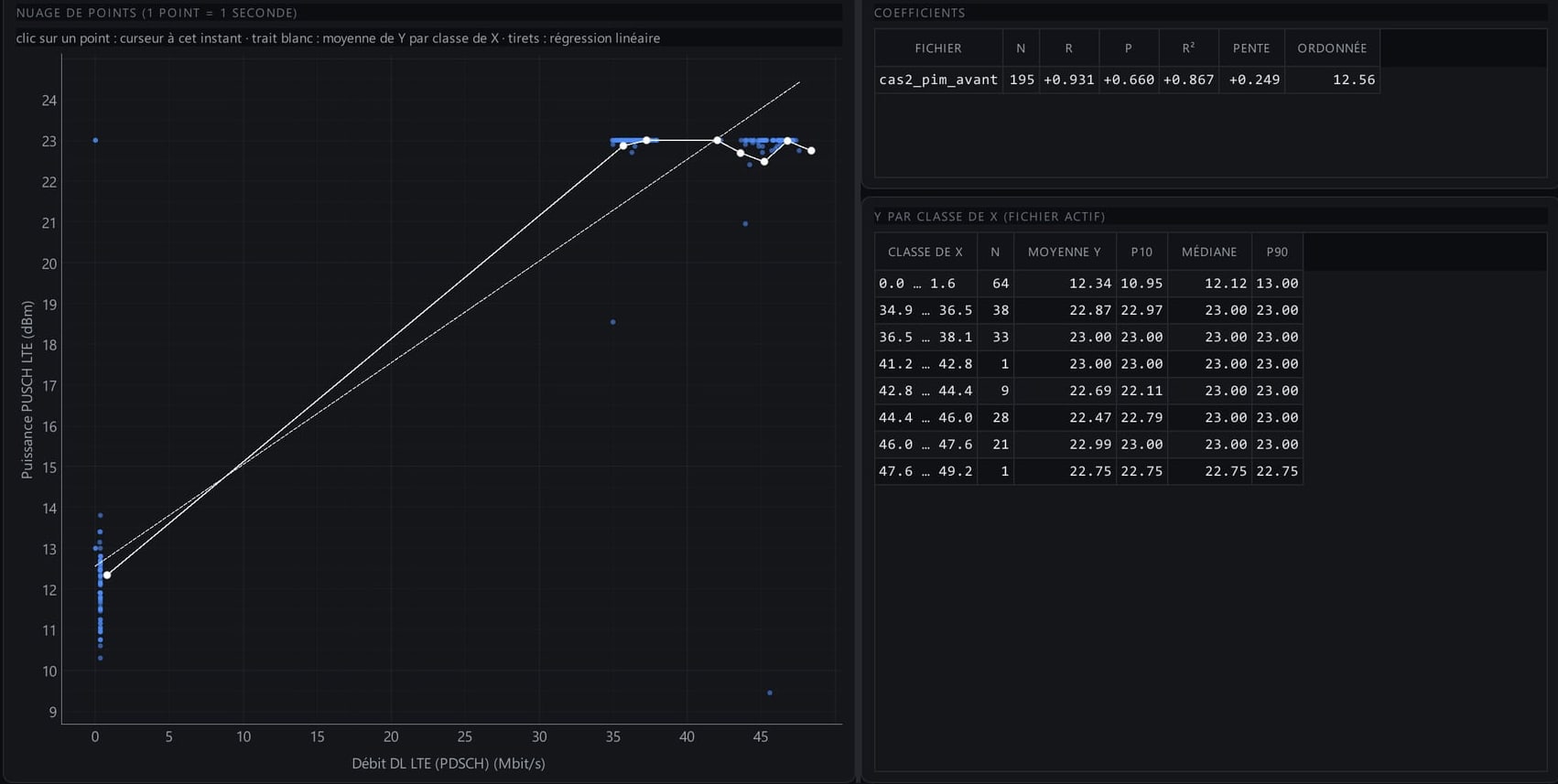
Stationary test point in a building covered by a shared multi-operator DAS, LTE band 20 (800 MHz), uplink, downlink and simultaneous tests.
- UL throughput, simultaneous test
- 1.0becomes15.5 Mbit/s
- PUSCH transmit power
- 23becomes11 dBm
- Correlation of DL throughput with UL power
- 0.93becomes−0.37
Symptom
Observations
Occupants of an office building report degraded video conferences and failed file uploads, even though the signal bars are full. The DAS downlink coverage is good: −85 dBm at the measurement point, with SINR around 20 dB.
Data collected
- An LTE test UE at stationary test point P on level 2: chipset trace, floor plan
- A sequence of three tests: uplink only, downlink only, simultaneous uplink and downlink
- Readout of PUSCH transmit power, uplink MCS and RBs, HARQ retransmissions
Lessons learned
Key points
- 01
Good downlink coverage says nothing about the uplink: check the UE transmit power.
- 02
Varying one load at a time—uplink, downlink, simultaneous—makes an intermittent symptom reproducible.
- 03
Uplink noise that correlates with the DAS downlink load points to passive intermodulation, before any search for an external interferer.
 3 min 44 s
Video · 3 min 44 s
Case studies: three RF investigations
Degraded 5G throughput on an urban route, uplink noise rise on a shared DAS, pilot pollution on a high floor: three investigations replayed in AKCELL Analyzer, from symptom to verification after correction.
Chapter “Uplink noise rise on a DAS” at 1:50
AKCELL Analyzer
The same method, applied to your own traces.
Post-processing software: synchronized replay, decoded signaling, event engine, low-throughput causes, before/after comparison, benchmarking and reports.